How Do Military Aircraft Achieve Speeds That No Commercial Airliner Can Match?
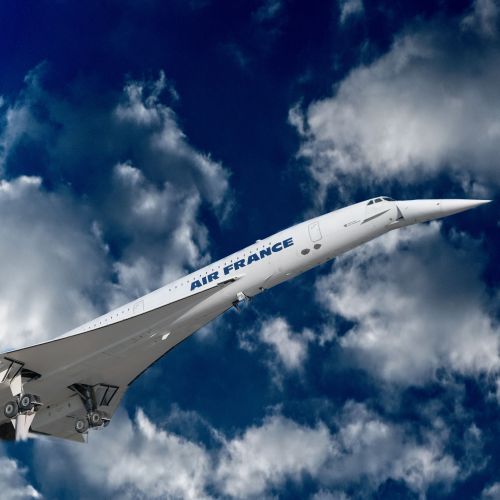
Military supersonic flight operates in a fundamentally different engineering world from commercial aviation. Where Concorde was constrained by passenger comfort, economics and noise regulations, military aircraft face a different set of demands entirely — speed, survivability, stealth and sustained performance in the most hostile environments imaginable. The engineering solutions that result are among the most technically extreme ever produced. Furthermore, they continue to influence every serious supersonic programme that follows.
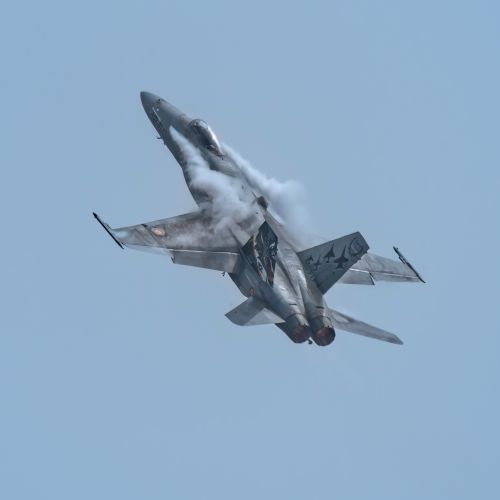
Three aircraft define the engineering spectrum of military supersonic flight — the SR-71 Blackbird, the F-22 Raptor and the Eurofighter Typhoon. Together they illustrate how different engineering priorities produce radically different solutions to the same fundamental challenge.
The Afterburner — Brute Force Supersonic
Most supersonic military aircraft achieve supersonic speeds the same way — with an afterburner. An afterburner injects raw fuel directly into the jet exhaust, igniting it to produce a powerful but extremely fuel-intensive burst of additional thrust. At full afterburner, a fighter engine burns fuel approximately three times faster than at normal power. The dramatic thrust increase overcomes the wave drag rise at Mach 1 and pushes the aircraft through the transonic regime into supersonic flight.
However, afterburner has significant limitations. It is extremely fuel-hungry. It produces a large infrared signature — making the aircraft visible to heat-seeking missiles. Furthermore, it generates a radar-reflective exhaust plume that compromises stealth. It cannot be sustained for extended periods without exhausting fuel reserves. Therefore, most conventional fighter aircraft achieve supersonic speeds but cannot sustain them in combat — they produce brief supersonic dashes rather than sustained supersonic cruise.
Supercruise — Sustained Supersonic Without Afterburner
The engineering advance that separates the most capable modern fighters from their predecessors is supercruise — the ability to sustain supersonic flight without afterburner. This requires an engine with sufficient baseline thrust to overcome transonic drag at supersonic speeds in dry power alone. That demands a fundamentally different powerplant — not simply a larger afterburner bolted to an existing design.
The F-22 Raptor achieves supercruise above Mach 1.5 using two Pratt and Whitney F119 engines. These produce sufficient dry thrust to sustain supersonic cruise in combat configuration — with weapons loaded and without afterburner. This is not simply a performance advantage. It is a tactical one. A supercruising F-22 generates no afterburner plume — reducing its infrared and radar signature at exactly the speeds where a conventional fighter would be most detectable. Consequently, supercruise is as much a survivability technology as a speed technology.
The Eurofighter Typhoon, powered by two EJ200 engines, can sustain brief periods above Mach 1 without afterburner in clean configuration at high altitude. Moreover, at Mach 1.3 in combat configuration with external stores, Typhoon pilots have confirmed supercruise capability — a significant achievement for a European combat aircraft and directly relevant to GCAP as the UK’s next-generation programme develops.
The SR-71 — Engineering at the Absolute Limit
The Lockheed SR-71 Blackbird remains, decades after its retirement, the fastest crewed air-breathing aircraft ever to enter operational service. It cruised at Mach 3.2 — not in a brief afterburner dash, but for hours at a time, at altitudes above 80,000 feet. The engineering required to achieve this pushed every material and propulsion discipline to its absolute limit.
At Mach 3.2, aerodynamic heating raises skin temperatures to between 300°C and 540°C across different areas of the airframe — far beyond the capability of conventional aluminium. Aluminium softens and loses structural integrity well below these temperatures. Therefore, the SR-71 required a fundamentally different structural material — one capable of retaining strength at extreme temperatures while remaining light enough to fly.
The answer was titanium. Approximately 93% of the SR-71’s airframe used a titanium alloy — specifically a beta alloy containing 13% vanadium, 11% chromium and 3% aluminium, chosen for its exceptional high-temperature strength and low thermal expansion. Low thermal expansion was critical. It minimised dimensional changes and associated structural stresses as the aircraft cycled through extreme temperature gradients on every mission.
The Black Paint — Engineering, Not Aesthetics
The SR-71’s iconic black paint — actually a very dark blue — was an engineering decision rather than an aesthetic one. Black surfaces both absorb and emit heat more efficiently than bare metal. As a result, the coating helped distribute thermal loads across the skin rather than allowing dangerous local concentrations. Lockheed’s Skunk Works engineers arrived at the solution through first principles rather than convention — and it became one of the most recognisable visual signatures in aviation history.
A Supply Chain Built on Cold War Intelligence
The procurement of sufficient titanium presented its own extraordinary engineering challenge. The United States lacked adequate domestic supply. The largest available source in the 1960s was the Soviet Union. Consequently, the CIA established front companies and indirect commercial channels to covertly purchase Soviet titanium — to build an aircraft whose primary mission was to spy on the Soviet Union. It remains one of the most remarkable supply chain stories in engineering history.
The J58 — A Revolutionary Propulsion Solution
The SR-71’s Pratt and Whitney J58 engines were as remarkable an engineering achievement as the airframe they powered. At Mach 3.2, a conventional turbojet cannot handle the high-temperature, high-pressure air arriving at its intake face. The compressor would stall and fail. Therefore, the J58 solved this by effectively transitioning from a turbojet to a ramjet at high speed.
At cruise conditions, bleed air from the compressor bypassed the turbine core entirely — flowing directly into the afterburner. The engine operated as a turbojet for starting and low-speed flight, transitioning progressively toward ramjet operation as speed increased. At Mach 3.2, the ram compression of the intake provided most of the pressure ratio the engine required. Furthermore, the SR-71 used JP-7 fuel — a specially formulated, extremely high flash-point kerosene that also served as a coolant, circulating through the airframe structure before reaching the engines. The fuel did not simply power the aircraft. It was an integral part of its thermal management system.
Stealth and Supersonic — The Modern Engineering Dilemma
The F-22 combines supersonic performance with stealth — two requirements that place significant conflicting demands on airframe design. Stealth requires smooth, carefully shaped external surfaces with no protrusions, recessed weapons bays and radar-absorbing materials. Supersonic performance requires sharp leading edges, area-ruled fuselage shaping and carefully managed shock wave geometry. Managing both simultaneously required sophisticated engineering compromises at every level.
Fixed geometry inlets — rather than the variable geometry ramps of earlier designs — were chosen partly for their stealth characteristics. Internal weapons carriage eliminates the radar-reflective drag penalty of external stores. Moreover, the aircraft’s carefully shaped planform meets both aerodynamic and radar cross-section requirements simultaneously. The engine exhausts incorporate serrated nozzle edges — reducing radar reflectivity at the cost of some propulsive efficiency. Therefore, every external feature of the F-22 reflects a design decision that balances supersonic aerodynamics against radar signature management — with neither requirement fully optimised in isolation.
What Military Supersonic Teaches Us
The engineering of military supersonic aircraft has consistently pushed materials, propulsion and aerodynamics beyond what commercial programmes would attempt. The SR-71’s titanium construction influenced aerospace materials engineering for decades. The F-22’s supercruise capability set the performance benchmark for sixth-generation programmes including GCAP. The Typhoon’s EJ200 engine demonstrated that European propulsion engineering could match American performance in key respects.
At CNR, precision mechanical engineering spans the aerospace and defence disciplines these aircraft demand — structural analysis, thermal management, propulsion integration and bespoke test rig development. The engineering thinking behind military supersonic flight is the same rigorous, first-principles approach that underpins every precision mechanical engineering challenge we tackle.
Note: This article is for general information only Image Credits: AI Generated