How Does Precision Engineering Determine How Far a Golf Ball Goes?
Most golfers think about swing technique when they want more distance. However, the engineering of the club in their hands has as much influence on ball flight as anything their body does. A modern golf driver is one of the most precisely engineered pieces of sports equipment in existence — the product of materials science, computational fluid dynamics, finite element analysis and additive manufacturing working together to extract every possible metre from a single swing.
Furthermore, the pace of innovation in golf club engineering is accelerating faster than at any point in the sport’s history. In 2026, clubs incorporate technologies borrowed directly from Formula 1, aerospace and advanced manufacturing — and the engineering story behind them is genuinely compelling.
The Driver — Engineering Under Constraint
The driver is the most engineered club in the bag — and the most constrained. The USGA and R&A govern every dimension that matters. Maximum clubhead volume is 460cc. Face deflection — the spring-like energy return of the face at impact — has a defined upper limit. Overall length, loft and face angle all fall within regulated ranges.
These constraints make driver engineering harder, not easier. Every manufacturer works within the same box. Therefore, competitive advantage comes entirely from engineering ingenuity — from how cleverly designers use the available volume, distribute the available mass and manage the aerodynamic behaviour of the head during the swing. The rules of golf do not limit ambition. They focus it.
Materials Engineering — From Wood to Titanium to Carbon
Golf club materials have transformed over the past 30 years. Wooden drivers gave way to steel, then to titanium, then to multi-material constructions that combine several engineered materials in a single clubhead.
Titanium dominates driver face construction. Its exceptional strength-to-weight ratio allows engineers to produce faces that are thin enough to flex significantly at impact — storing and returning energy to the ball — while remaining strong enough to survive millions of impact cycles. However, titanium has limits. Engineers cannot cast or stamp it any thinner without compromising weld integrity. Furthermore, the heat-affected zone around welds reduces local material properties — creating a constraint that conventional manufacturing cannot resolve.
Carbon fibre addresses this in a different way. Multi-layer carbon crowns and soles replace heavier titanium in areas of the clubhead that do not require the impact resistance of the face. Moving weight away from the crown and sole gives designers discretionary mass — grams they can reposition to optimise centre of gravity height, depth and lateral position. Moreover, carbon fibre components are significantly lighter than equivalent titanium parts — freeing weight that engineers can place precisely where performance demands it.
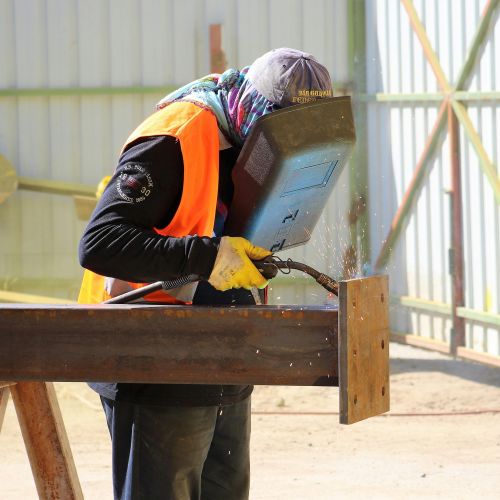
Fabrications require weld joint access for both welding and inspection. Joint designs should minimise distortion during welding and allow for correction where distortion cannot be avoided. Furthermore, assembly sequence must allow each weld to be completed before the geometry closes off access to adjacent joints. In other words, the sequence in which a fabrication is assembled is a design decision — not a manufacturing problem to solve later.
3D Printing — The Engineering Revolution in Golf
The most significant development in golf club engineering in recent years is additive manufacturing. Direct Metal Laser Sintering — DMLS — builds clubheads from metal powder, layer by microscopic layer, following a digital design file with no tooling constraints whatsoever.
Conventional manufacturing limits what geometry engineers can produce. Internal features, complex curves and variable wall thicknesses are either impossible or prohibitively expensive to machine. DMLS removes those limits entirely. Engineers can now design internal lattice structures — complex honeycomb geometries that are both extremely light and exceptionally strong. These structures allow precise weight redistribution that no casting or machining process could achieve. As Cobra’s engineering team found using HP Metal Jet 3D printing, additive manufacturing gives designers the freedom to move material exactly where performance demands it — while still conforming to the rules of golf.
Furthermore, the technology draws directly on experience from Formula 1 and aerospace engineering. CRP Group — a technical partner to Formula 1 teams for decades — applied the same additive manufacturing expertise they developed for racing to the golf industry, producing clubheads with geometries that are unlike anything conventional manufacturing could create. The most likely next step is a fully multi-material clubhead — a 3D-printed steel body, a CNC-milled titanium face, a carbon fibre crown and injected tungsten weights — each material placed where it performs best.
Centre of Gravity and Moment of Inertia
Two engineering parameters define driver performance more than any other — centre of gravity and moment of inertia.
Centre of gravity position determines how the club interacts with the ball at impact. A low, deep centre of gravity produces a higher launch angle and lower spin rate — generally the combination that maximises carry distance for most swing speeds. A forward centre of gravity reduces spin further but requires a more precise strike. Engineers position the centre of gravity by distributing mass across the clubhead — using dense materials like tungsten in specific locations to draw the centre of gravity to the optimal point.
Moment of inertia measures a clubhead’s resistance to twisting when the ball strikes away from the sweet spot. A high MOI clubhead twists less on off-centre hits — maintaining more ball speed and reducing the directional error that a mishit produces. Consequently, high MOI designs are more forgiving. However, they typically require mass distributed further from the centre — which conflicts with low, deep centre of gravity positioning. The engineering of a driver is therefore a continuous balancing act between competing performance objectives.
AI-Designed Club Faces
The 2026 generation of driver faces goes beyond what human designers can optimise manually. AI algorithms analyse thousands of impact scenarios and generate micro-variable thickness patterns across the face — thicker in some areas, thinner in others — that produce more consistent ball speed regardless of where on the face the ball strikes. The result is measurably better performance on mishits — the shots that determine scoring for the vast majority of golfers.
This is not simply an incremental improvement in face design. It represents a fundamental shift in how engineers approach the optimisation problem — delegating the detailed geometry decisions to computational intelligence while the human engineering team defines the performance objectives and validates the outcome. Moreover, the same AI design approach is extending to iron faces, wedge grinds and putter geometry — reshaping engineering practice across every club in the bag.
What Golf Club Engineering Tells Us
The engineering of a golf driver brings together materials science, precision manufacturing, computational design and aerodynamics in a single, constrained, intensely competitive product development challenge. The tolerances are tight, the regulatory framework is exacting and the performance margins between products are measured in fractions of a metre per second of ball speed.
These are precisely the engineering disciplines that CNR applies across aerospace, automotive, defence and research programmes — precision design, materials analysis, advanced manufacturing and computational optimisation. The thinking that produces a better driver is the same thinking that produces better engineering systems across every sector.
Note: This article is for general information only Image Credits: AI